eidolonlathi (![[personal profile]](https://www.dreamwidth.org/img/silk/identity/user.png) eidolonlathi) wrote2020-06-12 11:02 pm
eidolonlathi) wrote2020-06-12 11:02 pm
eidolonlathi) wrote2020-06-12 11:02 pm


About the war arc and more Importantly, about Zetsu
Once in a while I come across a reminder that initially the Akatsuki were planned to be full scale monsters and instantly feel glad this concept got dropped. What we've got with making them humans possessing strong monstrous traits was already more than enough: It’s already a contradiction the writing wants to show since most earliest chapters that the ninja system is flawed -because it goes against basic human nature- just to backpedal once stakes rise by literally robbing the newly arriving antagonists parts of their humanity.
It was a convenient device to keep the main characters' hands clean, but grew downright bizarre once the war arc had arrived and instead of showing a conflict based in the flaws the ninja system held, we got the "good guys" going against a mass consisting of nothing but zombies and plant blobs. Letting popular old characters return as zombies more often than not ended up cheapening the impact they've had when still alive, in some cases even retconning the entire point their character and death had held. (Sasori not being allowed to hold on to the grudges that had ruled the better part of his life? Due to some off-brand talk-no-justsu that was not even delivered by the orange ninja messiah himself? Really?)
And don’t get me started on the entire mess that were the Zetsu clones. After the Immortals arc it had already become more than obvious that whatever backstory had been planned out for Zetsu was going to be retconned, but not even allowing Zetsu to be human anymore? Certainly one way to avoid all the uncomfortable questions a character like his was raising.
With this point I’m biased, I admit: It’s an odd experience, having Zetsu as one of your faves and seeing how his characterization developed (declined) while the manga was still ongoing.
Looking at his introduction panel, it was implied he was a missing nin from hidden grass, the forehead plate with the crossed out village symbol recognizable enough around his neck. Then the story goes on and you get crumbs of information, like the fact he’s having the habit of disposing of some of Akatsuki’s targets by eating them. And then the story keeps going and you keep witnessing how his mind is very obviously split into two parts. And you see this and think, alright, that’s actually a nice way of “show, don’t tell”. How here the writing is showing what outlandish tasks the ninja system keeps demanding of its people, and the effect committing these atrocities can have on their minds: Another example enforcing the early theme of the manga that demanding people to act as nothing but human weapons while shaming them for showing emotion is just not going to work out in the long run and is doomed to create conflict.
And then part two keeps going on and with the introduction of Sasuke’s new teammate Jugo you get a second character whose mind got split into two due to the strain the ninja way of life was putting on this individual. And you think, yes, that’s a nice kind of parallel, showing like this that certain main themes in the story keep returning and stay consistent, and don’t even need to be addressed directly, instead allowing to have their own quiet impact.
And it’s things like these still making you wanting to continue reading this manga, even though, by the time Taka/Hebi are getting focus, the writing has already become frustrating in some parts. But some of your faves are still part of the story and you want to know what will happen to them, so you keep reading. And the further you read, the more you see patterns you don’t like that much. Like the by now familiar formula of an antagonist getting a sob story through flashbacks, the information often not ringing true with what we’ve seen of them this far, usually shortly before they’re made to leave the manga for good. And you look at Zetsu, who is still one of your favourites, and think, thank god that this one doesn’t have to shoulder one of those too convenient sob stories. Compared to those you prefer the more subtle writing of using present-timeline behaviour of an individual and parallels to similar characters to imply what the individual in question has been through in the past. It seems to fit so much better in this specific case anyway: You have problems to imagine how a flashback serving yet another sob story is supposed to work here. For Zetsu, who is so unapologetic about his less flattering habits like eating his targets, who doesn’t bother trying to hide that somewhere along the way his mind got split into two, who never was looking for understanding or sympathy for himself when interacting with other people to begin with.
Since his introduction your fave has been a side character, but you’re content with the few panels you get of him from time to time. Like him admitting towards Kakuzu and Hidan that ultimately everyone is alone and one can only rely on themselves. Thus admitting the feeling of alienation and detachment he ultimately experiences when interacting with the world. (In the same scene getting the revelation what for Kakuzu and Hidan is most important in life, Jashin-sama respectively the security of money. Another example the writing can still deliver some solid scenes if it only tries.)
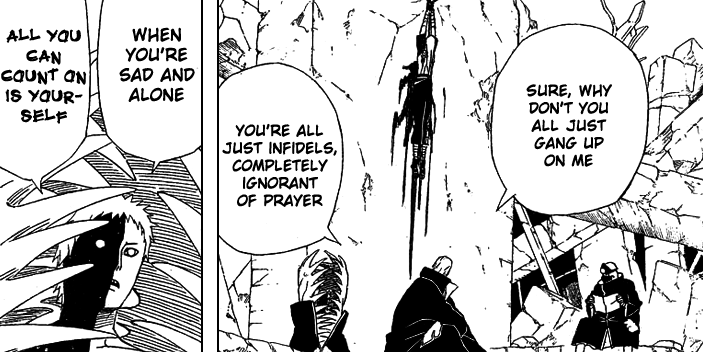
Hanging-with-the-bros-and-opening-up-to-them-time.
Or like him getting visibly upset that one time he got called a slur by Naruto (aloe vera, really…), so upset that the stricter side of Zetsu needed to calm the other side down, the character visibly shaken by the incident: Implying Naruto’s behaviour of throwing slurs against Zetsu’s unconventional outer appearance was not upsetting because it was a one-time-occurrence in this moment, but the apathetic reaction of Zetsu’s stricter part indicating it’s a type of reaction he’d come across often and is too familiar with at this point in time.

Rude. Very rude. I’d be shocked if it wasn’t that in character for our orange messiah.
Scenes like these are the kind of “show, don’t tell” moments that in your opinion say more about a character’s inner life than any sloppily tacked on tear jerker story. Or so you thought.
You’re already resigned to the fact that the war arc is getting worse with every new chapter and are asking yourself if keeping to read this mess is really worth it. But your fave is still in it, and you’re still asking yourself what might be up with these panels that indicate why it's actually Zetsu holding some authority over Tobi. The manga keeps droppings hints and you believe it will be explained how and why all of this is supposed to make any sense.
And then goes the manga: “Plant blob and void make creepy plant man!” The story decides that every hint it bothered to insert about Zetsu is no longer supposed to count. Gone are the indications of a picture that ultimately had always shown him as yet another human mind trying to find ways to cope with the atrocities the ninja system is demanding from its followers. The writing now wants you to believe he had been a full-scale monster all along, something about plant clones merging with a spirit of malevolence, something about surprise aliens from the moon.
It doesn’t make sense with what has been shown before, but you guess declaring a character aligned with uncomfortable issues such as a split mind and cannibalism to be a literal monster is more convenient than dealing with the question of humanity in these circumstances. Plus: Sympathetic backstories are given to the characters with wider audience appeal, and your fave has never been remotely popular, not even when the series was still ongoing.
Years later you remember the Akatsuki started out as the concept of a group of actual monsters. You feel like you’d should have seen the signs pointing to a disappointing ending much sooner: Something about how declaring it’s a story about the conflicts of human nature sounds great, but when it gets serious we’d better keep the hands of our main characters clean by letting them fight only against beings that can get dehumanized and conveniently get called monsters.
It was a convenient device to keep the main characters' hands clean, but grew downright bizarre once the war arc had arrived and instead of showing a conflict based in the flaws the ninja system held, we got the "good guys" going against a mass consisting of nothing but zombies and plant blobs. Letting popular old characters return as zombies more often than not ended up cheapening the impact they've had when still alive, in some cases even retconning the entire point their character and death had held. (Sasori not being allowed to hold on to the grudges that had ruled the better part of his life? Due to some off-brand talk-no-justsu that was not even delivered by the orange ninja messiah himself? Really?)
And don’t get me started on the entire mess that were the Zetsu clones. After the Immortals arc it had already become more than obvious that whatever backstory had been planned out for Zetsu was going to be retconned, but not even allowing Zetsu to be human anymore? Certainly one way to avoid all the uncomfortable questions a character like his was raising.
With this point I’m biased, I admit: It’s an odd experience, having Zetsu as one of your faves and seeing how his characterization developed (declined) while the manga was still ongoing.
Looking at his introduction panel, it was implied he was a missing nin from hidden grass, the forehead plate with the crossed out village symbol recognizable enough around his neck. Then the story goes on and you get crumbs of information, like the fact he’s having the habit of disposing of some of Akatsuki’s targets by eating them. And then the story keeps going and you keep witnessing how his mind is very obviously split into two parts. And you see this and think, alright, that’s actually a nice way of “show, don’t tell”. How here the writing is showing what outlandish tasks the ninja system keeps demanding of its people, and the effect committing these atrocities can have on their minds: Another example enforcing the early theme of the manga that demanding people to act as nothing but human weapons while shaming them for showing emotion is just not going to work out in the long run and is doomed to create conflict.
And then part two keeps going on and with the introduction of Sasuke’s new teammate Jugo you get a second character whose mind got split into two due to the strain the ninja way of life was putting on this individual. And you think, yes, that’s a nice kind of parallel, showing like this that certain main themes in the story keep returning and stay consistent, and don’t even need to be addressed directly, instead allowing to have their own quiet impact.
And it’s things like these still making you wanting to continue reading this manga, even though, by the time Taka/Hebi are getting focus, the writing has already become frustrating in some parts. But some of your faves are still part of the story and you want to know what will happen to them, so you keep reading. And the further you read, the more you see patterns you don’t like that much. Like the by now familiar formula of an antagonist getting a sob story through flashbacks, the information often not ringing true with what we’ve seen of them this far, usually shortly before they’re made to leave the manga for good. And you look at Zetsu, who is still one of your favourites, and think, thank god that this one doesn’t have to shoulder one of those too convenient sob stories. Compared to those you prefer the more subtle writing of using present-timeline behaviour of an individual and parallels to similar characters to imply what the individual in question has been through in the past. It seems to fit so much better in this specific case anyway: You have problems to imagine how a flashback serving yet another sob story is supposed to work here. For Zetsu, who is so unapologetic about his less flattering habits like eating his targets, who doesn’t bother trying to hide that somewhere along the way his mind got split into two, who never was looking for understanding or sympathy for himself when interacting with other people to begin with.
Since his introduction your fave has been a side character, but you’re content with the few panels you get of him from time to time. Like him admitting towards Kakuzu and Hidan that ultimately everyone is alone and one can only rely on themselves. Thus admitting the feeling of alienation and detachment he ultimately experiences when interacting with the world. (In the same scene getting the revelation what for Kakuzu and Hidan is most important in life, Jashin-sama respectively the security of money. Another example the writing can still deliver some solid scenes if it only tries.)
Hanging-with-the-bros-and-opening-up-to-them-time.
Or like him getting visibly upset that one time he got called a slur by Naruto (aloe vera, really…), so upset that the stricter side of Zetsu needed to calm the other side down, the character visibly shaken by the incident: Implying Naruto’s behaviour of throwing slurs against Zetsu’s unconventional outer appearance was not upsetting because it was a one-time-occurrence in this moment, but the apathetic reaction of Zetsu’s stricter part indicating it’s a type of reaction he’d come across often and is too familiar with at this point in time.
Rude. Very rude. I’d be shocked if it wasn’t that in character for our orange messiah.
Scenes like these are the kind of “show, don’t tell” moments that in your opinion say more about a character’s inner life than any sloppily tacked on tear jerker story. Or so you thought.
You’re already resigned to the fact that the war arc is getting worse with every new chapter and are asking yourself if keeping to read this mess is really worth it. But your fave is still in it, and you’re still asking yourself what might be up with these panels that indicate why it's actually Zetsu holding some authority over Tobi. The manga keeps droppings hints and you believe it will be explained how and why all of this is supposed to make any sense.
And then goes the manga: “Plant blob and void make creepy plant man!” The story decides that every hint it bothered to insert about Zetsu is no longer supposed to count. Gone are the indications of a picture that ultimately had always shown him as yet another human mind trying to find ways to cope with the atrocities the ninja system is demanding from its followers. The writing now wants you to believe he had been a full-scale monster all along, something about plant clones merging with a spirit of malevolence, something about surprise aliens from the moon.
It doesn’t make sense with what has been shown before, but you guess declaring a character aligned with uncomfortable issues such as a split mind and cannibalism to be a literal monster is more convenient than dealing with the question of humanity in these circumstances. Plus: Sympathetic backstories are given to the characters with wider audience appeal, and your fave has never been remotely popular, not even when the series was still ongoing.
Years later you remember the Akatsuki started out as the concept of a group of actual monsters. You feel like you’d should have seen the signs pointing to a disappointing ending much sooner: Something about how declaring it’s a story about the conflicts of human nature sounds great, but when it gets serious we’d better keep the hands of our main characters clean by letting them fight only against beings that can get dehumanized and conveniently get called monsters.